NBSM Lab
Sogang UniversityMech. Eng.
생명체에서 영감을 받아 이를 인공적으로 모사하거나 일부 생체시스템을 집적화한 마이크로·나노 디바이스를 설계, 제작하고, 물질 및 에너지 변환, 신호전달과 센싱, 그리고 컴퓨팅에 응용하는 연구를 하고 있습니다.


P.I. in NBSM Lab (NanoBiosystems and Manipulation Laboratory)
BK21 교육연구팀 팀장 (Head of the BK21 Education and Research Team)
Professor, Dept. of Mechanical Engineering, Sogang University
환영합니다. 본 연구실에 관심있는 학생은 박정열 교수(sortpark@sogang.ac.kr)에게 메일 주세요.
If you are interested in joining the NBSM, please contact Prof. Jungyul Park (sortpark@sogang.ac.kr).
우리 연구실은 생명체에서 영감을 받아 이를 인공적으로 모사하거나 일부 생체시스템을 집적화한 마이크로·나노 디바이스를 설계, 제작하고, 이를 이용해서 물질 및 에너지 변환, 신호전달 및 센싱, 그리고 컴퓨팅에 응용하는 연구를 하고 있습니다.

Various promising applications using self-assembly of nanostructures. Self-assembly of nanostructures opens up a number of exciting possibilities, including batteries, solar cells, photonic crystals, nanoplasmonics, and so on. When an assembly is highly organized and can be controlled locally and timely, not only is quality performance improved, but new opportunities and functions — such as genotyping, diagnosis, printing, or display — can be realized.

Our approach: Spatio-temporal control of nanostructure self-assembly using microfluidics and electrokinetics
For localized positioning in the microchannel or on the substrate, we use microfluidics and electrokinetics. Microfluidic phenomena, surface functionalization, inkjet printing, electrospinning, and other chemistry, physics, and tools are studied.
These well-organized structures enable the realization of energy harvesting, iontronics, optoelectronics, and biomedical microdevices.

We fabricate three-dimensional nanochannel network membranes (3D NCNMs) by combining capillary-guided nanoparticle confinement with evaporation-driven self-assembly. Nanoparticle suspensions are selectively trapped at predefined microchannel interfaces by a Laplace pressure barrier and subsequently self-assembled into highly ordered 3D structures, forming interconnected nanoscale pores. The resulting nanochannels exhibit ion-selective transport through electrical double-layer (EDL) overlap at the charged nanoparticle surfaces. By tailoring nanoparticle size, surface charge, and material properties, the ionic transport characteristics of the NCNM can be readily controlled. This versatile platform enables a wide range of applications in iontronics, energy harvesting and conversion, optoelectronics, and nanofluidic devices.


High-Performance Ionic Diodes Based on 3D Nanochannel Networks
We develop high-performance ionic diodes using three-dimensional nanochannel network membranes (3D NCNMs) with tailored geometry and surface charge. A homogeneously charged asymmetric NCNM enables unipolar ionic rectification through microscale geometric asymmetry while maintaining high ionic current through the interconnected 3D nanochannel network. Building on this concept, we further developed an asymmetric bipolar ionic diode by combining oppositely charged nanochannel regions with optimized microchannel geometry, achieving an ionic current rectification ratio of approximately 1,600. The strong rectification also enables efficient ion accumulation at the heterogeneous junction without electroconvective instability, which was utilized for highly sensitive Hg²⁺ detection down to 10 pM. These studies demonstrate the versatility of 3D NCNMs for controlling directional ion transport and enabling applications in ionic circuits, sensing, and energy conversion.
Representative works
High Current Ionic Diode Using Homogeneously Charged Asymmetric Nanochannel Network Membrane, Nano Letters (2016)
Asymmetric Nanochannel Network-Based Bipolar Ionic Diode, ACS Nano (2022)


Nanofluidic Energy Harvesting
We develop nanofluidic energy-conversion platforms that harvest electrical energy from salinity gradients by controlling selective ion transport through three-dimensional nanochannel network membranes (3D NCNMs). Inspired by the electric eel, we first demonstrated a high-voltage nanofluidic generator by alternately stacking cation- and anion-selective NCNMs, enabling the direct conversion of Gibbs free energy from ion-concentration gradients into electricity. The interconnected 3D nanochannel architecture provides high ionic conductance while maintaining strong ion selectivity, offering a scalable route toward clean and sustainable power generation.
Building on this concept, we further developed a plasmon-enhanced osmotic energy-conversion platform that combines light-induced surface-charge modulation with structurally optimized ion transport. Plasmonic excitation enhances the effective surface charge and ion selectivity of the NCNM, while a physics-informed genetic algorithm coupled with multiphysics simulations optimizes the bipolar nanochannel geometry for asymmetric ion transport. The synergistic combination of plasmonic enhancement and structural optimization significantly improves voltage, current, and power generation under both monochromatic and broadband solar illumination. Integration into a scalable series–parallel NCNM array further demonstrates the potential of this platform for high-performance blue-energy harvesting and sustainable power generation.
Representative works
High-voltage nanofluidic energy generator, Nano Energy (2018)
Plasmon-Enhanced Osmotic Energy Conversion via Physics-Informed Evolution of Nanochannel Networks, ACS Appl. Mater. Interfaces (2026)
This work was featured in news including YTN (link)

Wearable Biofuel Cells for Self-Powered Devices
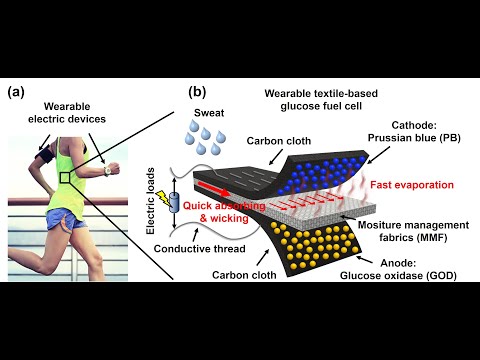
We develop flexible and sustainable biofuel cells that harvest energy directly from glucose in bodily fluids such as sweat and tears. A textile-based biofuel cell integrated with moisture-management fabric enables continuous fuel transport without an external pump, generating sufficient power from sweat to operate wearable electronics. By stacking multiple cells in series and parallel, the system achieved an open-circuit voltage of 1.08 V and a maximum power output of 80.2 μW, demonstrating its potential for integration into sportswear and other wearable platforms.
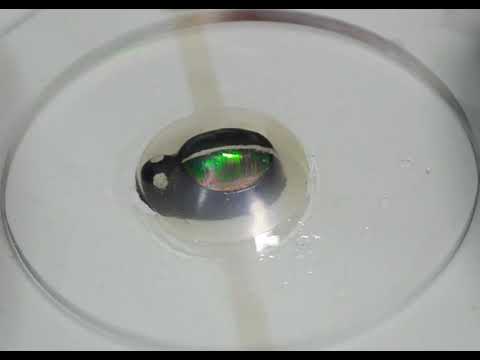
Extending this concept to ocular devices, we developed a safe and durable self-powered smart contact lens with fully embedded glucose fuel cells. The lens maintains stable power generation under repeated deformation and long-term storage, while integration with electroresponsive hydrogel capacitors enables visual differentiation of tear-glucose levels. These platforms demonstrate the potential of biofuel cells as self-sustaining power sources for next-generation wearable and biomedical devices.
Representative works
Sustainable and high-power wearable glucose biofuel cell using long-term and high-speed flow in sportswear fabrics, Biosensors and Bioelectronics (2020)
Safe, Durable, and Sustainable Self-Powered Smart Contact Lenses, ACS Nano (2022)
This work was featured in many news including Chosun (link)

Colorimetric sensors using photonic crystals. Many animals and plants display structural colors in their epidermis, based on nanostructures that respond visually to environmental cues. Photonic crystals (PCs) built from regular dielectric nanostructures reflect light at particular wavelengths by diffraction/interference (Bragg equation); when the periodic spacing changes, the bandgap shifts and the color change is visible to the eye.


A new class of flexible all-solid-state electrically tunable photonic crystals (ETPCs) is realized via chemically induced polymer swelling and lattice control using dielectric elastomer actuators, showing a wide color range (red→blue-green) with low hysteresis and long-term stable operation. Featured in donga science (link)
AI-Driven Inverse Engineering of Phononic Crystals — We combine artificial intelligence with multiphysics simulations to inversely design phononic crystals with tailored bandgaps and defect modes, enabling rapid optimization of acoustic and elastic-wave control for sensing, vibration suppression, and other wave-engineering applications.


Measurement and Analysis of Internal Stress in HBM — Internal stress estimation using multilayer MEMS deices


International journal papers, listed by year (most recent first). Click a year to expand.


Professor · Research Professors & Postdocs · Integrated M.S.&Ph.D. · M.S. · Undergraduate · Alumni

수상, 언론보도, 학회 발표, 연구비 선정 등 연구실 소식입니다.


연구실 활동, 학회 발표, 세미나 사진을 위한 자리입니다. 사진을 클릭하면 설명과 함께 큰 화면으로 볼 수 있습니다.


Undergraduate & graduate courses taught by Prof. Jungyul Park.
Dynamic analysis of engineering models — mass, mass-spring-damper systems, rigid and non-rigid bodies. Relative motion, work & energy, impact & momentum.
Mathematical methods for mechanical engineering — linear algebra, domain transformation and numerical methods applied to mechanical systems.
Experiments on soft-lithography fabrication, laminar flow observation/analysis in microchannels, and diffusion principles.
Mathematical modeling of biological systems — cell migration, molecular diffusion, population ecology, electrophysiology, disease transmission — via ODEs/PDEs, stability analysis and phase portraits, plus nanoscale sensing and optical imaging tools.
Recent research trends in nanobiosystems, top-down/bottom-up fabrication methods, and modeling/design problems.
All class materials are available via Cyber Campus.
대학원생(석·박사) 및 학부연구생을 상시 모집하고 있습니다. International students are very welcome.
현재의 실력보다는 연구에 열정을 가지신 분, 그 열정을 노력으로 승화시킬 수 있는 분이면 누구든지 환영합니다. 공학(기계, 화공, 전자 등) 또는 이학(생물, 화학, 물리) 배경이 도움이 되지만, 새로운 융합 연구 분야에 도전하고 싶은 분이라면 누구나 환영합니다.